 Geobru catalogue
perspective.brussels
Type of resources
Available actions
Topics
INSPIRE themes
Keywords
Contact for the resource
Provided by
Years
Formats
Representation types
Update frequencies
status
Scale
-
School contract is a regional program for urban renewal. It aims to upgrade school neighbourhoods in Brussels and strengthen the relationship between schools and their surroundings.
-
This dataset corresponds to the Special Land-Use Plans (les Plans Particulier d'Affectation du Sol or PPAS in French and de Bijzondere Bestemmingsplannen or BBP in Dutch). The dataset consists of a single layer showing the general perimeter of the PPAS, without identifying each specific land-use zone or its nature. It can be consulted via an ad hoc WMS and WFS. This dataset has no regulatory value and is published solely for informational purposes. Only the maps and subsequent amendments published in the Belgian Official Gazette have regulatory force.
-
This dataset represents the land use zoning elements set out in the map of the Regional Land Use Plan (le Plan Régional d’Affectation du Sol or PRAS in French and het Gewestelijk Bestemmingsplan or GBP in Dutch). It consists of a single geometry layer showing the zoning elements (without the overlays of the zone of regional interest with deferred development and of the zones of cultural, historical, aesthetic or embellishment interest). All PRAS layers are freely available via an ad hoc WMS and WFS. This dataset has no regulatory value and is published for information purposes only. Only the maps and subsequent amendments published in the Belgian Official Gazette have regulatory force.
-
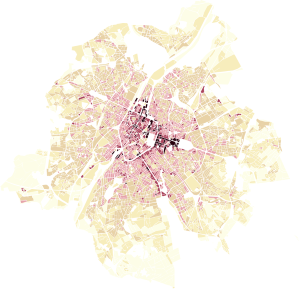
This dataset represents the built density of urban blocks within the territory of the Brussels-Capital Region. It provides four indicators: the floor space index (FSI), the ground space index (GSI), the average number of storeys, and the maximum building height.
-
This dataset corresponds to the urban renewal area (URA). This zone brings together disadvantaged neighborhoods where the public sector increases its investments. This zone was designated by the Brussels-Capital Region with the aim of improving residents’ quality of life and socio-economic integration, and of creating a new dynamic for the development of the local economy. A first zone was defined in 2016. The boundaries were revised in 2019 and 2026, and this new URA has been in effect since September 2026.